> ## Documentation Index
> Fetch the complete documentation index at: https://v3.docs.derive.xyz/llms.txt
> Use this file to discover all available pages before exploring further.
# Access Scopes
> The two scope sets that bound what a session key may do.
Every [session key](/authentication/session-keys) carries **two independent scope sets**, enforced by two different layers:
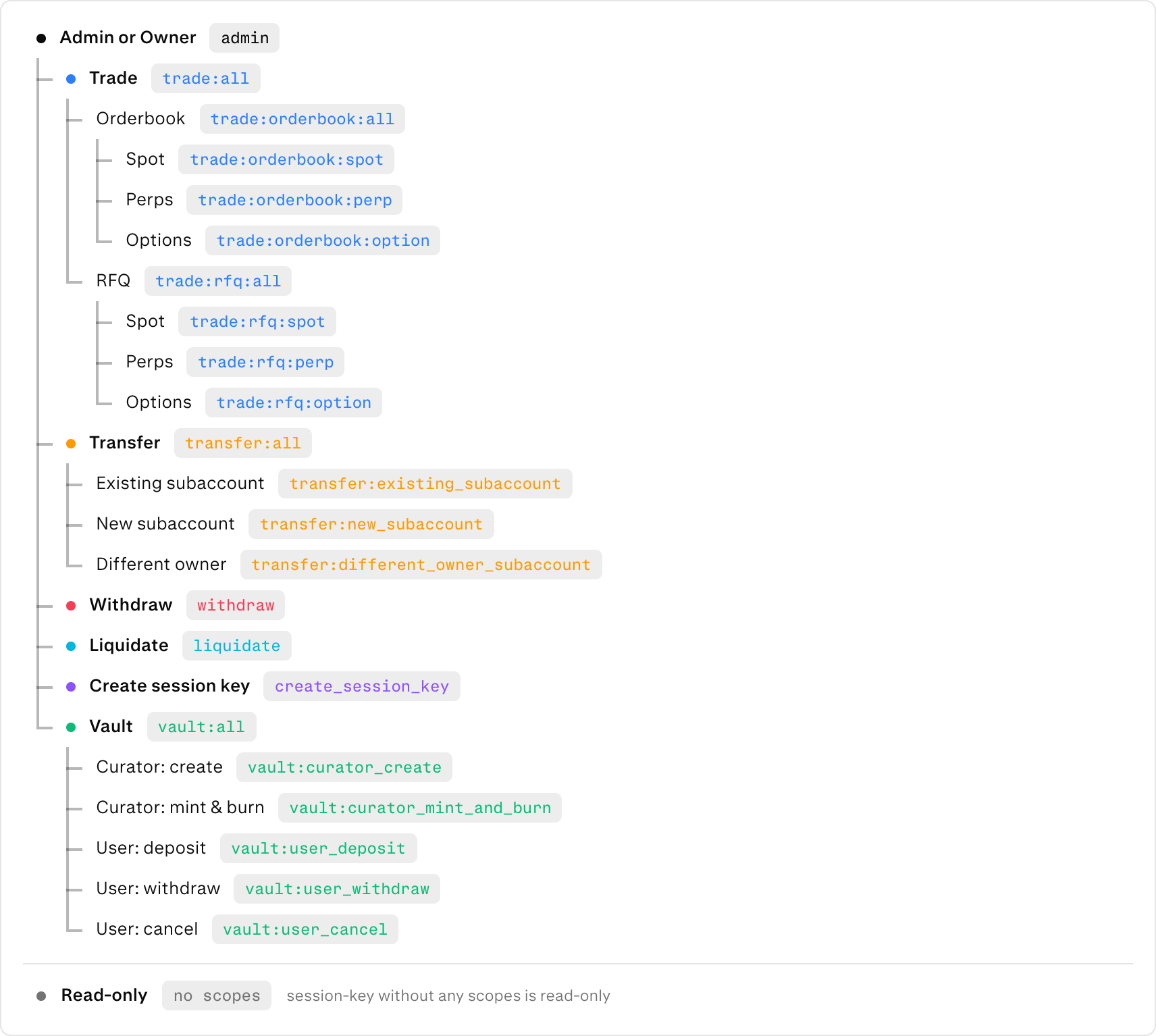
* **Protocol scopes** — on-chain authority. Signed into each action and re-validated by the protocol state machine. These decide what state-changing actions the key can authorize.
* **Off-chain scopes** — server-side capabilities. Never signed, never seen by the protocol; enforced only by the server before a request is processed.
All of the steps in this guide can be done through the UX or SDKs.
## Protocol scopes
Protocol scopes form a **tree**. A grant for a branch covers everything under it, so `trade:all` covers `trade:orderbook:all` and `trade:rfq:option` alike, and `all` at any level covers its children. A request is checked by asking whether one of the key's grants *allows* the specific scope the action requires.
 ## Off-chain scopes
Off-chain scopes are exact-match only — no tree, no hierarchy.
| Wire string | Grants |
| -------------------- | ------------------------------------------------------------------------------------------------------------------------------------------------------------------------------------------------------------------------------------ |
| `account_info` | Read-tier account capability. This is the scope synthesized for JWT (wallet-token) sessions — the capability a logged-in browser session holds. Gates `private/change_subaccount_label` and a label-only `private/edit_session_key`. |
| `delete_session_key` | Intended to guard session-key deletion, which the protocol itself does not restrict. |
## Defaults and how scopes are set
There is no implicit default: a newly created key holds **exactly** the scopes its create request carried. Omit `protocol_scopes` and the key has no protocol authority; omit `offchain_scopes` and it has no off-chain capability.
Two scope sets are also synthesized at auth time (not stored):
* **Direct wallet auth** → protocol `admin`, no off-chain scopes (admin bypasses off-chain gates).
* **JWT / wallet-token auth** → off-chain `account_info`, no protocol scopes (read-only; cannot authorize actions).
Call `private/create_session_key`. The caller must hold the `create_session_key` protocol scope. `protocol_scopes`
are ABI-encoded into the signed action and re-validated in-protocol; `offchain_scopes` are validated but stay
server-side. Child scopes must be a subset of the signing parent (delegated attenuation).
Call `private/edit_session_key` to change `label`, `ip_whitelist`, or `offchain_scopes`. **Protocol scopes are not
editable here** — to add or remove protocol authority, create a new key.
```typescript TypeScript (SDK) theme={null}
import { Wallet } from 'ethers';
import {
DeriveClient,
OffchainScope,
ProtocolScopeCode,
} from '@derivexyz/derive-ts';
const client = new DeriveClient({
network: 'testnet',
wallet: process.env.PRIVATE_KEY!,
});
// create_session_key is an action-signed private call: open and authenticate first.
await client.connect();
await client.login();
// Generate the key locally — only its address is registered.
const sessionKey = Wallet.createRandom();
const created = await client.sessionKeys.create({
publicSessionKey: sessionKey,
expirySec: Math.floor(Date.now() / 1000) + 30 * 24 * 3600, // the KEY's lifetime: 30 days
protocolScopes: [
ProtocolScopeCode.TradeOrderbookAll,
ProtocolScopeCode.TradeRfqOption,
],
offchainScopes: [OffchainScope.AccountInfo],
label: 'trading-bot',
});
// The ack echoes exactly what the key holds — there is no implicit default:
console.log(created.protocol_scopes); // ['trade:orderbook:all', 'trade:rfq:option']
console.log(created.offchain_scopes); // ['account_info']
```
```python Python (SDK) theme={null}
# Coming soon.
```
```rust Rust (SDK) theme={null}
// Coming soon.
```
```bash cURL theme={null}
# Body nonce/signature: EIP-712 action signing under the create-session-key
# module (see /action-signing). X-Derive* headers: session auth (see /json-rpc).
curl -X POST https://api.derive.xyz/v3/private/create_session_key \
-H "Content-Type: application/json" \
-H "X-DeriveWallet: $WALLET_ADDRESS" \
-H "X-DeriveTimestamp: $TS" \
-H "X-DeriveSignature: $SIG" \
-d '{
"wallet": "0xYourWallet",
"public_session_key": "0xSessionKeyAddress",
"expiry_sec": 1733592000,
"subaccount_ids": null,
"nonce": "1730999700000123000",
"signature_expiry_sec": 1731000600,
"signer": "0xYourWallet",
"signature": "0x…",
"protocol_scopes": ["trade:orderbook:all", "trade:rfq:option"],
"offchain_scopes": ["account_info"],
"label": "trading-bot"
}'
```
See [Session keys](/authentication/session-keys) for the full create / edit / list lifecycle and
[Authentication](/authentication/session-login) for how a session resolves to protocol and off-chain scopes. Amounts
and constants referenced by signed actions live on [Action signing](/authentication/action-signing).
## Related topics
- [New features](/migrating/new-features.md)
- [Market Maker Protection](/trading/market-maker-protection.md)
- [Session Keys](/authentication/session-keys.md)
## Off-chain scopes
Off-chain scopes are exact-match only — no tree, no hierarchy.
| Wire string | Grants |
| -------------------- | ------------------------------------------------------------------------------------------------------------------------------------------------------------------------------------------------------------------------------------ |
| `account_info` | Read-tier account capability. This is the scope synthesized for JWT (wallet-token) sessions — the capability a logged-in browser session holds. Gates `private/change_subaccount_label` and a label-only `private/edit_session_key`. |
| `delete_session_key` | Intended to guard session-key deletion, which the protocol itself does not restrict. |
## Defaults and how scopes are set
There is no implicit default: a newly created key holds **exactly** the scopes its create request carried. Omit `protocol_scopes` and the key has no protocol authority; omit `offchain_scopes` and it has no off-chain capability.
Two scope sets are also synthesized at auth time (not stored):
* **Direct wallet auth** → protocol `admin`, no off-chain scopes (admin bypasses off-chain gates).
* **JWT / wallet-token auth** → off-chain `account_info`, no protocol scopes (read-only; cannot authorize actions).
Call `private/create_session_key`. The caller must hold the `create_session_key` protocol scope. `protocol_scopes`
are ABI-encoded into the signed action and re-validated in-protocol; `offchain_scopes` are validated but stay
server-side. Child scopes must be a subset of the signing parent (delegated attenuation).
Call `private/edit_session_key` to change `label`, `ip_whitelist`, or `offchain_scopes`. **Protocol scopes are not
editable here** — to add or remove protocol authority, create a new key.
```typescript TypeScript (SDK) theme={null}
import { Wallet } from 'ethers';
import {
DeriveClient,
OffchainScope,
ProtocolScopeCode,
} from '@derivexyz/derive-ts';
const client = new DeriveClient({
network: 'testnet',
wallet: process.env.PRIVATE_KEY!,
});
// create_session_key is an action-signed private call: open and authenticate first.
await client.connect();
await client.login();
// Generate the key locally — only its address is registered.
const sessionKey = Wallet.createRandom();
const created = await client.sessionKeys.create({
publicSessionKey: sessionKey,
expirySec: Math.floor(Date.now() / 1000) + 30 * 24 * 3600, // the KEY's lifetime: 30 days
protocolScopes: [
ProtocolScopeCode.TradeOrderbookAll,
ProtocolScopeCode.TradeRfqOption,
],
offchainScopes: [OffchainScope.AccountInfo],
label: 'trading-bot',
});
// The ack echoes exactly what the key holds — there is no implicit default:
console.log(created.protocol_scopes); // ['trade:orderbook:all', 'trade:rfq:option']
console.log(created.offchain_scopes); // ['account_info']
```
```python Python (SDK) theme={null}
# Coming soon.
```
```rust Rust (SDK) theme={null}
// Coming soon.
```
```bash cURL theme={null}
# Body nonce/signature: EIP-712 action signing under the create-session-key
# module (see /action-signing). X-Derive* headers: session auth (see /json-rpc).
curl -X POST https://api.derive.xyz/v3/private/create_session_key \
-H "Content-Type: application/json" \
-H "X-DeriveWallet: $WALLET_ADDRESS" \
-H "X-DeriveTimestamp: $TS" \
-H "X-DeriveSignature: $SIG" \
-d '{
"wallet": "0xYourWallet",
"public_session_key": "0xSessionKeyAddress",
"expiry_sec": 1733592000,
"subaccount_ids": null,
"nonce": "1730999700000123000",
"signature_expiry_sec": 1731000600,
"signer": "0xYourWallet",
"signature": "0x…",
"protocol_scopes": ["trade:orderbook:all", "trade:rfq:option"],
"offchain_scopes": ["account_info"],
"label": "trading-bot"
}'
```
See [Session keys](/authentication/session-keys) for the full create / edit / list lifecycle and
[Authentication](/authentication/session-login) for how a session resolves to protocol and off-chain scopes. Amounts
and constants referenced by signed actions live on [Action signing](/authentication/action-signing).
## Related topics
- [New features](/migrating/new-features.md)
- [Market Maker Protection](/trading/market-maker-protection.md)
- [Session Keys](/authentication/session-keys.md)